.png)
On the surface, Google Cloud Compute pricing appears straightforward. You choose a machine, deploy it, and pay for what you use. But as usage scales, pricing becomes more nuanced. Discounts are automatically applied for sustained usage, and deeper savings are available through Committed Use Discounts (CUDs), which require a one- or three-year commitment.
This is where complexity begins. While committed pricing can significantly reduce Google Cloud compute costs compared to on-demand rates, it also introduces financial exposure if your usage drops below the committed level. Many teams understand the pricing models individually but struggle to determine the right commitment strategy for their workloads.
In this guide, we’ll break down how Google Cloud Compute pricing works, what factors influence your bill, and how to approach commitment decisions in a way that balances savings with flexibility.
How Google Cloud Compute Pricing Works
Google Cloud Compute pricing is based on the resources your virtual machine consumes and how long it runs. Instances are billed per second, with a one-minute minimum. Your total cost depends on machine type, region, operating system, and pricing model selected.
Generally, every Compute Engine bill is shaped by four core components: compute resources, location, usage duration, and discount structure.
Let’s break that down.
1. Machine Type (vCPU + Memory)
Every virtual machine in Google Cloud is defined by how much compute power and memory it has. A machine with more vCPUs and RAM costs more per second than a smaller one.
For example, general-purpose families like E2 or N2 are designed for balanced workloads, while compute-optimized machines (such as C-series) cost more because they provide higher processing performance.
You can also create custom machine types, which allow you to select specific vCPU and memory combinations. Pricing adjusts proportionally based on what you configure.
Below is a simplified breakdown of major Google Cloud machine families and their typical use cases.
2. Region
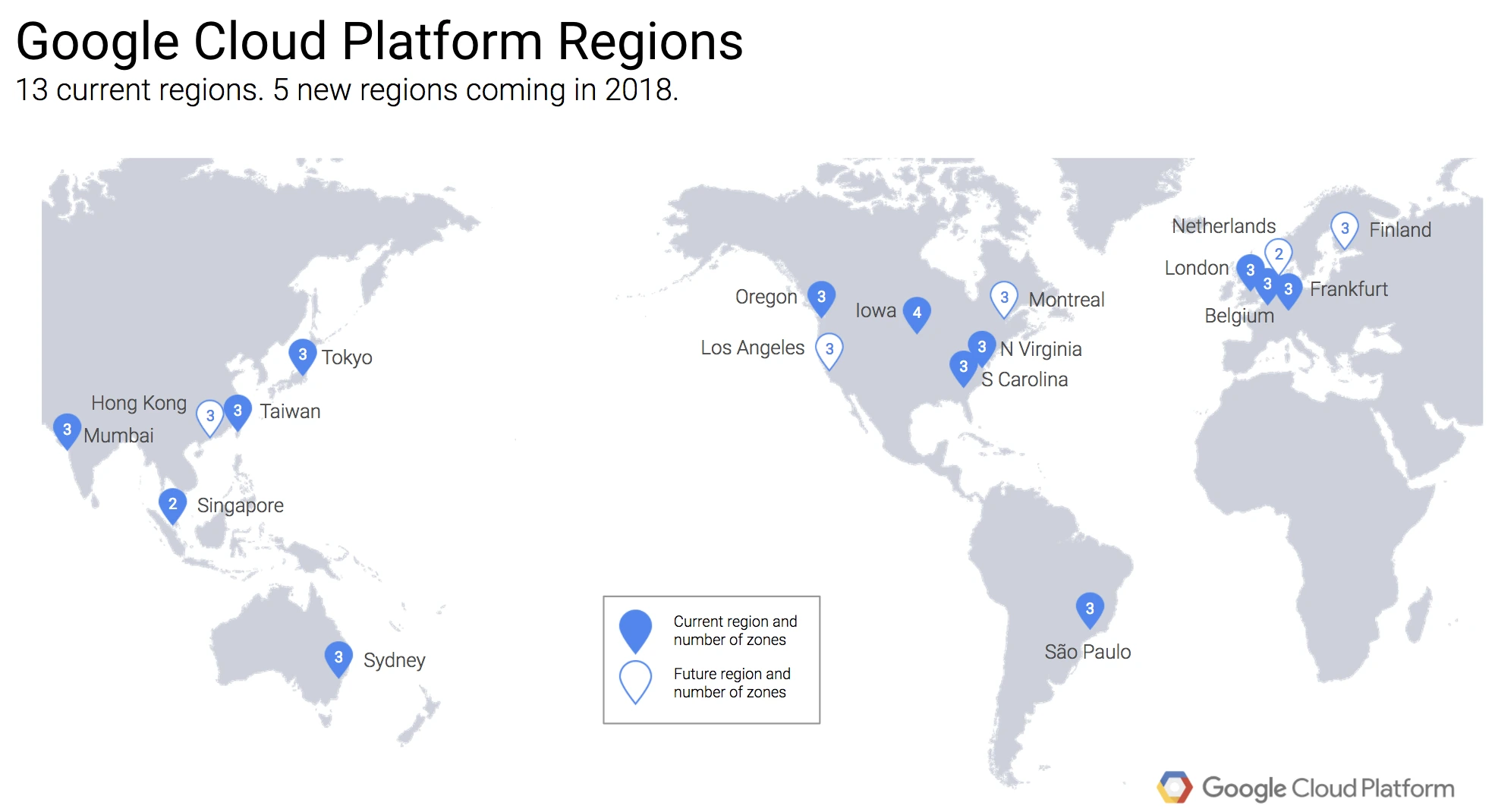
Google Cloud Compute pricing varies by region. Running the same machine type in Iowa will cost a different amount than running it in Frankfurt or Tokyo.
Regions with higher infrastructure and operational costs typically have higher instance pricing. Latency requirements, compliance needs, and data residency laws often influence regional selection, which indirectly affects cost.
This is why two companies running identical workloads can have different compute bills.
Source: Google Cloud
3. Usage Duration (Per-Second Billing)
Google Cloud bills Compute Engine instances per second, after a one-minute minimum. This granular billing model allows workloads that scale up and down to avoid paying for unused hours.
If a virtual machine runs for 10 minutes, you pay for 10 minutes, not a full hour. This makes short-lived or autoscaled workloads more cost-efficient compared to traditional hourly billing models.
However, per-second billing applies to on-demand rates. Deeper savings require different pricing structures.
4. Discount Model
This is where Google Cloud Compute pricing becomes more strategic.
There are three pricing structures available:
- On-demand pricing
- Sustained Use Discounts
- Committed Use Discounts (CUDs)
On-demand pricing is the default. You pay standard rates with no long-term commitment.
Sustained Use Discounts are applied automatically when a machine runs for a significant portion of the month. The more consistently it runs, the larger the discount applied to that usage.
Committed Use Discounts require you to commit to a specific level of vCPU and memory usage for one or three years in exchange for lower rates. This model provides predictable discounted pricing in exchange for contractual commitment. This is where cost savings and financial risk intersect.
Also read: GCP Committed Use Discount vs Sustained Use Discount
How Much Can You Save With Google Cloud Committed Use Discounts?
One of the biggest reasons teams explore Google Cloud Compute pricing discounts is the potential savings from Committed Use Discounts (CUDs).
According to Google Cloud, Committed Use Discounts can reduce Compute Engine costs by up to approximately 57% compared to on-demand pricing, depending on machine type and term length.
The exact savings depend on three factors:
- The machine family selected
- Whether you choose a one-year or three-year commitment
- How consistently your workloads run
In general, longer commitments offer deeper discounts. A three-year committed use contract typically delivers greater savings than a one-year term. However, longer commitments also increase financial exposure if usage declines.
This is where Google Cloud Compute pricing optimization becomes more strategic than simply selecting a discount option.
What Are Committed Use Discounts (CUDs)?
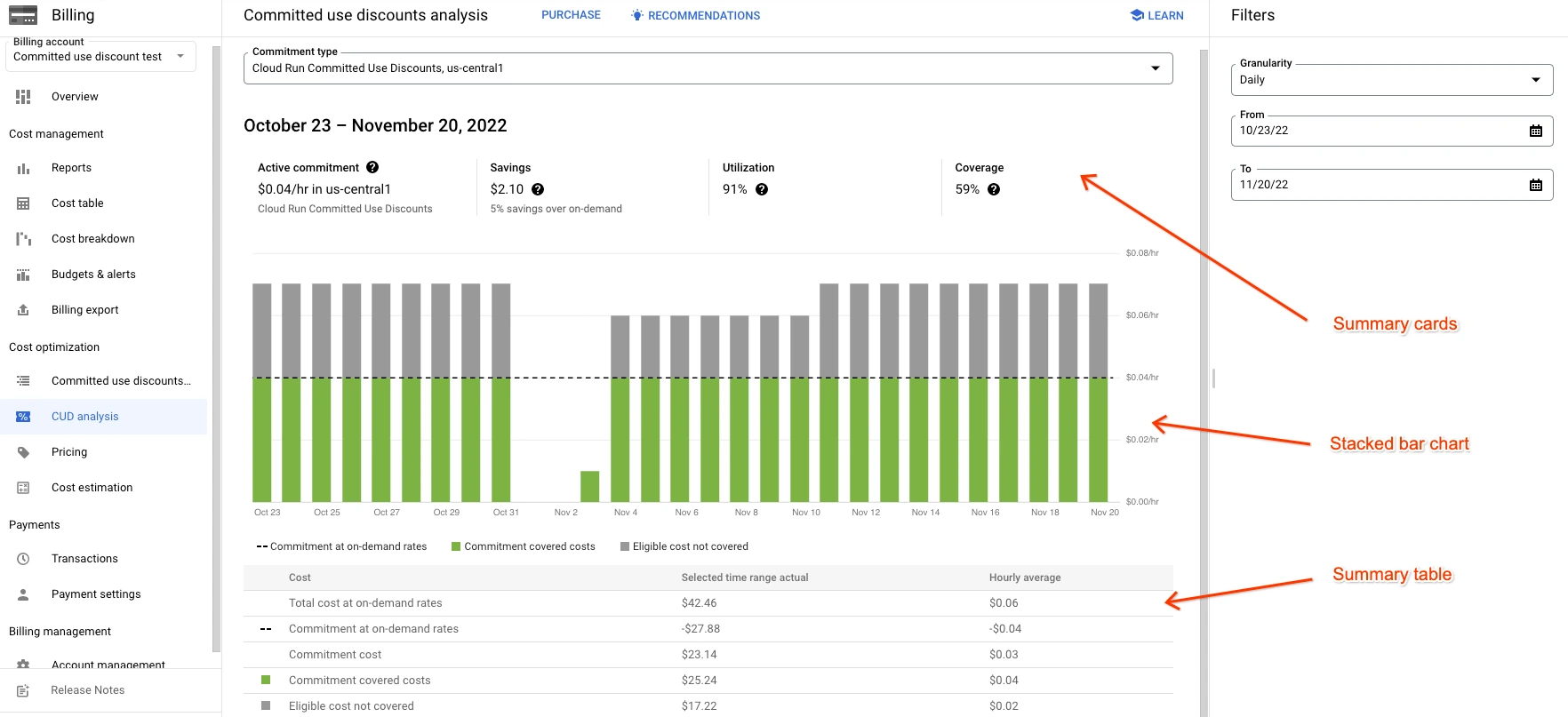
Committed Use Discounts allow you to commit to a specific level of vCPU and memory usage for one or three years in exchange for discounted rates. Instead of paying the full on-demand rate for every virtual machine, you agree to a baseline level of compute usage.
- If your usage stays at or above that committed level, you realize the discounted pricing.
- If your usage falls below the commitment, you still pay for the committed amount.
That tradeoff is central to Google Cloud Compute pricing strategy.
Source: Google Cloud
For example, imagine a workload that consistently runs $10,000 per month in on-demand Google Cloud Compute pricing.
With a 1-year committed use discount, that cost could drop significantly depending on the machine family. With a 3-year commitment, the monthly rate may decrease further, but only if usage remains stable.
This is why savings are not just about a discount percentage. They are about utilization consistency.
Also read: What Is GCP IAM? Roles, Policies & Best Practices
What Is Commitment Coverage?
When evaluating Google Cloud Compute pricing, most teams focus on discount percentages. But the more important metric is commitment coverage.
Commitment coverage refers to the percentage of your steady-state compute usage that is protected by Committed Use Discounts (CUDs) instead of paying on-demand rates.
In simple terms, coverage measures how much of your cloud workload is running on discounted pricing.
How Commitment Coverage Works
Imagine your workloads consistently consume the equivalent of 1,000 vCPUs per month. If you purchase Committed Use Discounts covering 600 vCPUs, your commitment coverage is 60%.
That means:
- 60% of your compute usage receives discounted pricing.
- 40% continues to run at on-demand rates.
The higher your coverage, the more you reduce your average Google Cloud Compute cost, assuming your usage remains stable.
Why Commitment Coverage Matters in Google Cloud Compute Pricing
The goal of Google Cloud cost optimization is not simply to buy commitments. It is to increase coverage safely.
If coverage is too low, you leave savings on the table and overpay on on-demand pricing. But then, if coverage is too high, you risk underutilization. When usage drops below your committed level, you still pay for the full commitment.
This is where many teams hesitate. They under-commit to avoid risk, which limits savings. Or they over-commit during growth periods and later absorb wasted spend when workloads shrink.
Google Cloud Compute pricing strategy is therefore a balancing act between maximizing coverage and minimizing utilization risk.
Coverage vs. Savings: The Hidden Relationship
Savings are not determined only by discount percentage. They are determined by Discount rate, Coverage percentage and Usage consistency.
You could secure a 50% discount on paper. But if you only cover 30% of your baseline usage, your effective savings across total compute spend will be much lower.
That’s why mature FinOps teams track commitment coverage as a core KPI.
The Hidden Risk of Google Cloud Commitments
While Google Cloud Compute pricing discounts can significantly reduce on-demand rates, Committed Use Discounts introduce a financial obligation that many teams underestimate.
When you purchase a commitment, you agree to pay for a fixed level of compute usage for one or three years. That payment obligation does not adjust automatically if your workloads shrink.
If your actual usage falls below the committed level, you still pay for the full commitment. This is known as utilization risk.
What Happens If Usage Drops?
Let’s assume your organization commits to 1,000 vCPUs under a three-year Committed Use Discount because your current workloads consistently consume that amount. Six months later, one of the following happens:
- A major customer churns
- An internal system is decommissioned
- A migration project reduces compute needs
- Engineering improves efficiency
If your usage drops to 700 vCPUs, you still pay for 1,000. The 300 vCPUs difference becomes wasted spend.
Google Cloud does not automatically refund unused committed capacity. The discount applies only if you consume the committed baseline.
Why Many Teams Under-Commit
Because of this utilization risk, many organizations intentionally keep commitment coverage low. They prefer paying higher on-demand rates rather than locking into long-term commitments that might exceed future demand.
This conservative approach reduces downside exposure, but it also leaves savings unrealized. As a result, Google Cloud Compute pricing optimization becomes more of a risk management exercise than a cost reduction exercise.
Also read: Why Cloud Cost Management Keeps Failing (and What Teams Are Missing)
The Real Tradeoff: Savings vs Flexibility
Google Cloud Compute pricing forces a strategic decision between lower per-unit cost and operational flexibility.
On-demand pricing offers maximum flexibility but at higher rates. Committed Use Discounts provide lower rates but require long-term commitments that may not adjust if workloads change.
On-demand pricing allows you to scale down instantly without financial obligation, but you pay premium rates.
Sustained Use Discounts reduce costs automatically without locking you into a contract, making them a middle-ground option within Google Cloud Compute pricing.
Committed Use Discounts offer the deepest savings, but the longer the term, the greater the exposure if usage declines.
This is why advanced Google Cloud cost optimization strategies focus not just on discount percentages, but on calibrated commitment coverage.
How to Optimize Google Cloud Compute Pricing (Step-by-Step Framework)
Optimizing Google Cloud Compute pricing is not about selecting the biggest discount. It is about building a commitment strategy that balances savings with flexibility.
Below is a structured framework used by mature FinOps teams to reduce compute costs while controlling utilization risk.
Step 1: Establish Your Baseline Usage
Before purchasing any Committed Use Discounts, you need to understand your steady-state compute usage.
Baseline usage represents the minimum level of vCPU and memory consumption your workloads consistently require over time.
So, instead of looking at a single month, analyze at least 30–90 days of usage data to identify:
- Stable workloads
- Seasonal spikes
- Growth or decline trends
Your baseline should reflect the portion of usage that is unlikely to disappear.
If your Google Cloud Compute usage fluctuates between 800 and 1,200 vCPUs, your safe baseline may be closer to 800, and not 1,200.
This baseline becomes the foundation of your commitment coverage strategy.
Step 2: Calculate Safe Commitment Coverage
Once baseline usage is identified, determine how much of it you are comfortable committing. Not all baseline usage should necessarily be covered. Your coverage decision depends on:
- Business volatility
- Product maturity
- Infrastructure roadmap
- Risk tolerance
For example, if your baseline usage is 800 vCPUs and you commit to 600, your commitment coverage is 75% of baseline. That leaves 200 vCPUs flexible under on-demand pricing.
This layered approach reduces the risk of over-commitment while still capturing meaningful savings.
Higher coverage increases average savings but reduces margin for usage decline.
Optimizing Google Cloud Compute pricing requires finding the balance that aligns with your organization’s growth outlook.
Step 3: Choose the Right Commitment Term
Google Cloud Committed Use Discounts are available in one-year and three-year terms. Longer commitments typically offer deeper discounts. However, they also extend your financial obligation.
If your infrastructure is:
- Rapidly evolving → shorter term may reduce risk
- Stable and predictable → longer term may maximize savings
The decision should reflect workload stability, not just discount percentage.
Step 4: Monitor Utilization Continuously
Optimization does not end after purchasing a commitment. Workloads change, engineering optimizes systems, traffic fluctuates and even products pivot. Therefore, commitment utilization should be reviewed regularly to ensure:
- Coverage remains aligned with actual usage
- New commitments are added when safe
- Over-commitment risk is avoided
Also read: Slash Your GCP Bill by 30-50% in 5 Minutes: The Complete Setup Guide
Google Cloud Pricing Calculator vs Real Compute Cost Optimization
When evaluating Google Cloud Compute pricing, many teams rely on the Google Cloud pricing calculator to model projected infrastructure costs.
The calculator is helpful. It allows you to select a machine type, choose a region, estimate usage, and generate a projected monthly cost. For budgeting and architecture planning, that’s useful.
The calculator assumes static inputs. However, Google Cloud cost optimization is not deterministic. It is probabilistic and utilization-dependent.
Below is a more technical breakdown of how the Google Cloud pricing calculator differs from real-world commitment optimization.
The calculator outputs a projected monthly number. Optimization, on the other hand calculates an effective blended rate based on On-demand spend, Committed Use Discount spend, Coverage percentage and Utilization rate.
This blended rate determines your true Google Cloud Compute cost efficiency.
The Utilization Variable
Committed Use Discounts reduce per-unit cost only if utilization remains at or above the committed baseline.
Utilization rate can be calculated as:
Utilization % = Actual Usage / Committed Usage
If utilization drops below 100%, the effective savings rate declines.
For example, if you commit to 1,000 vCPUs but consume only 800, utilization is 80%. The remaining 20% represents paid but unused committed capacity, increasing your effective cost per vCPU.
The Google Cloud pricing calculator does not model this scenario automatically.
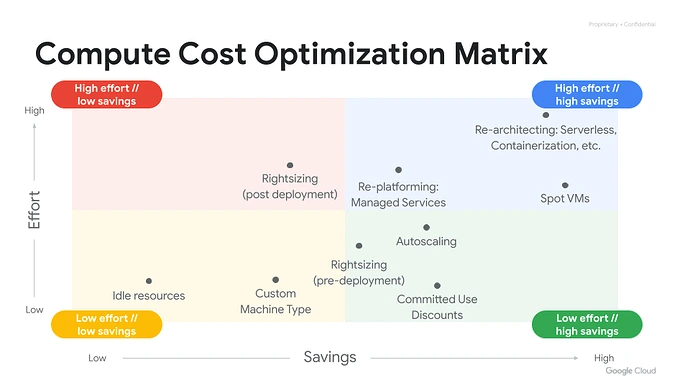
Source: Google Cloud
Why This Matters for Google Cloud Compute Pricing Strategy
Two organizations may model identical Google Cloud Compute Engine pricing scenarios in the calculator.
If one maintains 98–100% commitment utilization and the other averages 75%, their effective compute costs will diverge significantly.
The pricing calculator shows potential discount percentages, while optimization determines realized savings. That difference is driven by:
- Commitment coverage calibration
- Continuous monitoring of utilization
- Risk-adjusted commitment strategy
Understanding Google Cloud Compute pricing requires understanding not only rate tables, but utilization dynamics and coverage mathematics.
Advanced Strategy: Increasing Coverage Without Increasing Risk
In Google Cloud Compute pricing, increasing commitment coverage is the fastest way to reduce blended compute cost. However, increasing coverage also increases exposure to utilization risk.
The Risk-Adjusted Coverage Model
Traditional commitment strategies often rely on static historical averages. Teams review the past 30–90 days of usage and commit to a percentage of that baseline. This approach assumes stability.
A more advanced approach models variability and downside risk. Instead of asking: “What was our average usage?”, advanced teams ask: “What is our statistically safe minimum usage under volatility?”
This shifts the model from average-based commitment to floor-based commitment planning.
Note: Risk-adjusted coverage increases commitment levels while incorporating volatility buffers to protect against underutilization.
Incorporating Volatility into Commitment Planning
Google Cloud Compute usage typically fluctuates due to:
- Traffic seasonality
- Product releases
- Engineering optimizations
- Customer churn
- Infrastructure migrations
Instead of committing to 100% of observed baseline usage, risk-adjusted strategies often apply a volatility buffer.
For example, if your baseline usage averages 1,000 vCPUs but historical low points drop to 850, a risk-adjusted strategy may commit to 800–850 vCPUs rather than 1,000.
This maintains high commitment coverage while reducing the probability of underutilization.
Also read: Cloud Cost Monitoring vs Cost Control: What’s the Real Difference?
Increasing Coverage Through Monitoring and Adjustment
Another advanced strategy within Google Cloud Compute pricing optimization is incremental commitment layering.
Instead of purchasing a single large Committed Use Discount, teams:
- Start with a conservative baseline
- Monitor utilization rates continuously
- Add incremental commitments as confidence increases
This staged commitment approach reduces downside risk while allowing coverage to scale over time. It effectively transforms commitment purchasing from a one-time decision into a rolling optimization process.
Measuring Effective Blended Compute Cost
Ultimately, the goal of increasing commitment coverage safely is to reduce effective blended cost per vCPU.
Effective Blended Rate can be calculated as:
Effective Rate = (On−DemandSpend + CommittedSpend) / Total vCPU Usage
As commitment coverage increases and utilization remains high, the blended rate declines. If utilization falls, the blended rate increases.
This is why continuous monitoring of Coverage percentage, Utilization rate, and Volatility trends is critical to long-term Google Cloud cost optimization.
Google Cloud vs AWS Compute Pricing (Quick Comparison)
When evaluating Google Cloud Compute pricing, many organizations compare it directly with AWS. Both providers offer per-second billing, multiple instance families, and long-term commitment discounts, but the mechanics differ.
Understanding these differences is critical when building a multi-cloud cost optimization strategy.
The structural difference between resource-based commitments (Google Cloud) and spend-based commitments (AWS) changes how optimization is approached.
With Google Cloud Compute pricing, commitment modeling focuses on:
- Stable vCPU and memory baselines
- Regional workload consistency
- Coverage percentage relative to compute floor
With AWS Savings Plans, optimization focuses on:
- Predictable hourly spend
- Cross-instance usage flexibility
- Spend coverage alignment
Conclusion
Optimizing Google Cloud Compute pricing becomes less about selecting instance types and more about structuring commitment coverage, monitoring utilization rates, and managing workload volatility. A disciplined commitment strategy helps reduce compute spend, support growth, and keep your focus on the initiatives that matter most to your business.
You can start your exploration with Google Cloud’s $300 free trial credit to test Compute Engine workloads and see how different pricing models impact your costs in practice.
Frequently Asked Questions
1. How is Google Cloud Compute pricing calculated?
Google Cloud Compute pricing is based on machine type, vCPU and memory configuration, region, operating system, runtime duration, and selected discount model. Instances are billed per second, with costs varying by location and configuration. Additional savings may apply through Sustained Use Discounts or Committed Use Discounts.
2. What are Committed Use Discounts (CUDs) in Google Cloud?
Committed Use Discounts (CUDs) allow customers to commit to a specific amount of vCPU and memory usage for one or three years in exchange for discounted rates. If actual usage falls below the committed level, customers still pay for the full commitment.
3. How much can you save with Google Cloud Committed Use Discounts?
Google Cloud Committed Use Discounts can reduce Compute Engine costs by up to approximately 57% compared to on-demand pricing, depending on machine type and commitment term. Actual savings depend on commitment coverage and utilization rate.
4. What is commitment coverage in Google Cloud Compute pricing?
Commitment coverage is the percentage of your baseline compute usage protected by Committed Use Discounts. Higher coverage can increase savings but also increases risk if usage declines below the committed level.
5. What happens if you underutilize a Google Cloud commitment?
If actual compute usage falls below the committed level, you still pay for the full Committed Use Discount amount. Underutilization increases your effective blended cost per vCPU and reduces realized savings.
6. Is Google Cloud cheaper than AWS for compute?
Google Cloud and AWS offer competitive compute pricing with similar per-second billing and long-term commitment discounts. Actual cost differences depend on machine type, region, commitment structure, utilization rate, and coverage strategy rather than list price alone.
7. Does Google Cloud offer a free trial for Compute Engine?
Yes. Google Cloud offers a free trial that includes $300 in credits for new customers, which can be used to test Compute Engine and other services. This allows teams to explore Google Cloud Compute pricing before committing to production workloads.